SCFHS-accredited course
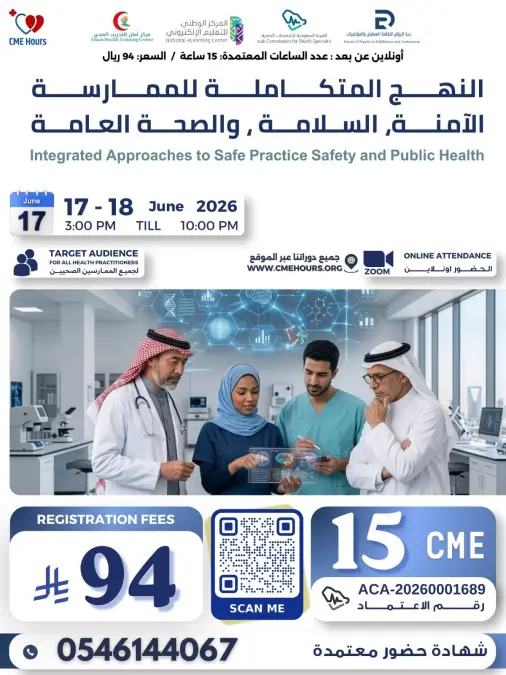
Integrated Approaches to Safe Practice Safety and Public Health #2
Durrat Riyadh for Exhibition Organizing
Registration Ended

Live online via Zoom
SCFHS-accredited
Attendance certificate
Hours uploaded 2-4 days after the course
Course Objectives
Complete a knowledge-based post-activity exam to validate understanding and clinical application.
Conduct structured case-based discussions to apply learning in simulated real-world scenarios.
Demonstrate how to report, escalate, and follow up on patient safety incidents using local systems.
Implement strategies to address burnout, fatigue, and staffing challenges that compromise safety.
Critique healthcare policies and workplace cultures that impact safety behaviors and outcomes.
Collaborate with infection control and public health teams to manage communicable disease risks.
Design patient education strategies to enhance medication adherence and reduce avoidable hospitalizations.
Interpret cardiovascular red flags and high-risk findings that require urgent multidisciplinary response.
Formulate effective action plans following safety incidents, including near-miss and sentinel events.
Demonstrate cultural competence and patient engagement strategies to reduce disparities in care.
Distinguish between system-level failures and individual accountability in incident analysis.
Use safety data, dashboards, and quality indicators to monitor and improve clinical performance.
Integrate national and international patient safety goals into daily professional practice.
Assess the influence of public health emergencies on patient safety and healthcare service delivery.
Implement standardized protocols and checklists to enhance team reliability and reduce variability in care.
Explain the impact of poor communication on patient outcomes and how to improve handoff and documentation processes.
Illustrate best practices for infection prevention and control relevant to all healthcare professionals.
Evaluate the role of clinical decision support systems in minimizing diagnostic and treatment errors.
Recognize early warning signs of patient deterioration in both acute and ambulatory care settings.
Demonstrate interprofessional collaboration techniques to manage high-risk clinical situations effectively.
Apply evidence-based strategies to reduce medication errors and enhance medication safety.
Analyze root causes of adverse events using structured tools such as RCA and FMEA.
Identify common patient safety risks and system failures that contribute to preventable harm in various healthcare settings.
Describe the core principles of safe clinical practice applicable across all healthcare disciplines
Course Schedule
Scientific Program: Competency in Patient Safety & Clinical Risk Management
Wednesday, June 17, 2026
| Time | Details |
|---|---|
| 03:00 PM 04:00 PM |
Core Principles of Safe Practice Across Professions
Lecture
|
| 04:00 PM 05:00 PM |
Identifying and Managing Common Patient Safety Risks
Lecture
|
| 05:00 PM 06:00 PM |
Public Health Concepts in Clinical Decision-Making
Lecture
|
| 06:00 PM 07:00 PM |
Acute Patient Deterioration: Team-Based Response
Lecture
|
| 07:00 PM 07:15 PM |
Prayer and Break |
| 07:15 PM 07:45 PM |
Systems Thinking and Safety Culture in Healthcare
Lecture
|
| 07:45 PM 08:15 PM |
Medication Safety and Error Prevention Strategies (e.g., Contrast-Related Adverse Reactions)
Lecture
|
| 08:15 PM 08:45 PM |
Communication Failures and Hand-off Errors
Lecture
|
| 08:45 PM 09:15 PM |
Early Warning Signs: What Every Professional Should Know
Lecture
|
| 09:15 PM 09:45 PM |
Reporting and Learning from Near Misses
Lecture
|
| 09:45 PM 10:15 PM |
Using Safety Dashboards and Quality Indicators
Lecture
|
| 10:15 PM 10:45 PM |
Public Health Emergencies and Healthcare Coordination
Lecture
|
| 10:45 PM 11:15 PM |
Panel: Multidisciplinary Safety Insights
Panel Discussion
|
| 11:15 PM 11:30 PM |
Open Discussion Session
|
Thursday, June 18, 2026
| Time | Details |
|---|---|
| 04:00 PM 04:30 PM |
Root Cause Analysis (RCA) and FMEA in Practice
Lecture
|
| 04:30 PM 05:15 PM |
Safety in Cardiovascular Emergencies
Lecture
|
| 05:15 PM 06:00 PM |
Infection Control and Public Safety Measures
Role of respiratory therapists in infection control, airborne precautions, and ventilator-associated pneumonia (VAP) protocols.
Lecture
|
| 06:00 PM 07:00 PM |
High-Risk Medications and Monitoring Parameters
Lecture
|
| 07:00 PM 07:15 PM |
Prayer and Break |
| 07:15 PM 07:45 PM |
Diagnostic Errors and Clinical Decision Support
Lecture
|
| 07:45 PM 08:15 PM |
Ethics, Consent, and Safety in Vulnerable Populations
Lecture
|
| 08:15 PM 08:45 PM |
Interprofessional Teamwork in Crisis Management
Joint Presentation
|
| 08:45 PM 09:15 PM |
Psychological Safety and Error Disclosure
Lecture
|
| 09:15 PM 09:45 PM |
Leadership Roles in Promoting Safety Culture
Lecture
|
| 09:45 PM 10:15 PM |
Clinical Case Scenario (Structured Simulation)
Practical Application Session
|
| 10:15 PM 10:45 PM |
Final Knowledge Assessment (Comprehensive Exam)
Evaluation
|
| 10:45 PM 11:00 PM |
Discussion & Concluding Remarks (Salah Al-Din Saadallah Zween, Mohamed Ali Hameed, Yasmine Ahmed Mahdy) |
Total CME Hours: 15:00 Accredited Hours
Target Audience
For All Health Practitioners
Accreditation Information
Accreditation number: ACA-20260001689
Activity organizing entity: Aman co. treatment health training
More Upcoming Courses
Other accredited courses you might like