SCFHS-accredited course
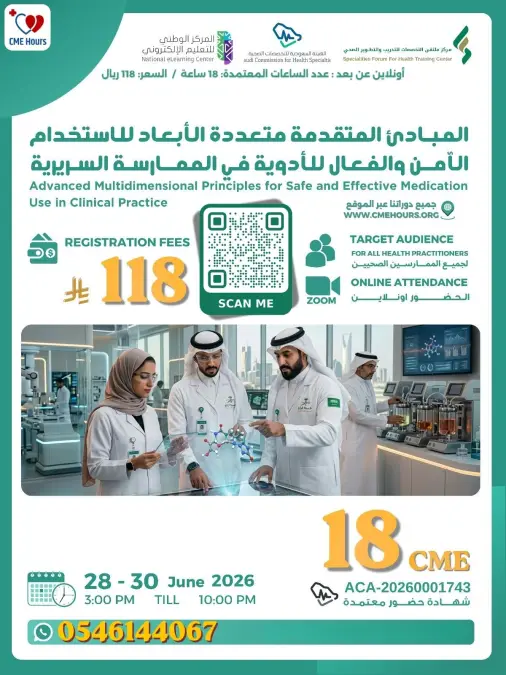
Advanced Multidimensional Principles for Safe and Effective Medication Use in Clinical Practice #2
Specialities Forum For Health Training Center
Registration Ended

Live online via Zoom
SCFHS-accredited
Attendance certificate
Hours uploaded 2-4 days after the course
Course Objectives
Explain the core principles of rational medication use and factors influencing medication-related outcomes, including pharmacokinetics, pharmacodynamics, and patient-specific variables (e.g., age, renal function, comorbidities)
Assess and manage drug-related problems, such as adverse drug reactions, drug interactions, and medication errors and align with SFDA regulations through interdisciplinary dialogue
Demonstrate effective interprofessional communication skills to coordinate care related to medication use
Implement patient education strategies to improve medication adherence and facilitate shared decision-making
Evaluate reliable sources of information for medication by applying evidence-based guidelines for medication selection and use
Perform dosage calculations and renal dose adjustments with accuracy including those undergoing dialysis
Describe and manage various drug interactions (drug-drug, drug-food, drug-disease, drug -laboratory)
Explain legal, ethical, and regulatory considerations for prescribing medications, including off-label use and informed consent
Classify different categories of OTC medications, their indications, mechanisms, side effects, and contraindications
Describe and apply strategies for managing medications during pregnancy and lactation for both pregnancy-associated and pre-existing conditions
Assess and evaluate age-related pharmacokinetic and pharmacodynamic changes in Pediatric/Neonates & Geriatric to support optimal drug therapy
Differentiate between the various phases of hepatic drug metabolism and their clinical implications
Describe the main principles of Antimicrobials in clinical practice
Identify the responsibilities of nurses in safe and effective medication management
Identify the commonly used medications in dental medications and ensure their safe use before, during, and after dental procedures
Integrate pharmacological knowledge into physiotherapy and rehabilitation to optimize patient outcomes
Analyze the role of dietitians in identifying and managing medication-nutrition interactions to enhance patient outcomes and optimize therapeutic efficacy
Evaluate the role of radiology professionals in the safe selection, administration, and monitoring of medications used in imaging procedures, including contrast agents, sedatives, and adjunct therapies
Assess the responsibilities of health administrators in developing policies, ensuring regulatory compliance, managing budgets, and coordinating with healthcare teams to optimize safe and effective medication use
Implement system-level quality improvement (QI) tools to enhance medication management and reduce errors
Apply evidence-based medication strategies to manage psychological health conditions, considering pharmacologic mechanisms, patient-specific factors, and social influences
Summarize current and emerging trends in medication safety through panel discussion and interdisciplinary perspectives including health systems and community roles
Demonstrate competency in safe, rational, and evidence-based medication practices
Analyze clinical case scenarios to apply integrated medication use principles with awareness of social, administrative, and behavioral factors
Course Schedule
Scientific Program: Integrated Safe & Rational Medication Management
Day 1: Sunday, June 28, 2026
| Time | Details |
|---|---|
| 03:00 PM 04:00 PM |
Core Principles of Medication Use in Healthcare
Basic principles of pharmacology and commonly used terminology.
Lecture
|
| 04:00 PM 05:00 PM |
Medication Errors and Adverse Drug Reactions
Risk prevention and remediation strategies in clinical setups.
Lecture
|
| 05:00 PM 06:00 PM |
Interprofessional Communication Skills Essential for Medication Management Processes
Lecture
|
| 06:00 PM 07:00 PM |
Medication Adherence Strategies and Patient Education
Lecture
|
| 07:00 PM 07:15 PM |
Panel Discussion (Salahuddin Saadullah Zewain, Mohamed Abdelmonem Al-Arian) |
| 07:15 PM 08:15 PM |
Human Factors and Systems Thinking in Medication Management
Lecture
|
| 08:15 PM 09:15 PM |
Understanding SFDA Risk Classification and Reporting Tools
Lecture
|
| 09:15 PM 10:15 PM |
Evidence-Based Practice: Evaluating Types of Clinical Literature
Lecture
|
| 10:15 PM 11:15 PM |
Dosage Calculations and Dose Adjustment in Renal Diseases and Dialysis Types
Lecture
|
| 11:15 PM 11:30 PM |
Panel Discussion (Akram Al-Qubasi, Mohamed Abdelmonem Al-Arian) |
Day 2: Monday, June 29, 2026
| Time | Details |
|---|---|
| 03:00 PM 04:00 PM |
Medication Use in Dental Practice: What Every Dentist Should Know
Lecture
|
| 04:00 PM 05:00 PM |
Understanding Drug-Laboratory Test Consideration and Therapeutic Drug Monitoring (TDM)
Implications for optimal clinical practice and tracking.
Lecture
|
| 05:00 PM 06:00 PM |
Medication Use in Emergency and Critical Care Settings
Lecture
|
| 06:00 PM 07:00 PM |
Drug Interactions Management in Clinical Practice
In-depth review of drug-drug, drug-food, and drug-disease cross-reactions.
Lecture
|
| 07:00 PM 07:15 PM |
Panel Discussion (Akram Al-Qubasi, Salahuddin Saadullah Zewain) |
| 07:15 PM 08:15 PM |
Legal, Ethical, and Regulatory Considerations for Medication Use
Lecture
|
| 08:15 PM 09:15 PM |
Preventing Polypharmacy and Deprescribing in Complex Patients
Lecture
|
| 09:15 PM 10:15 PM |
Over-the-Counter (OTC) Medications: Balanced Use and Misuse Risks
Lecture
|
| 10:15 PM 11:15 PM |
Medication Use in Pregnancy and Lactation: Safe Clinical Decision-Making
Lecture
|
| 11:15 PM 11:30 PM |
Joint Panel Discussion (Salahuddin Saadullah Zewain, Mohamed Abdelmonem Al-Arian, Akram Al-Qubasi) |
Day 3: Tuesday, June 30, 2026
| Time | Details |
|---|---|
| 03:00 PM 04:00 PM |
Pediatric and Neonatal Pharmacokinetics
Unique therapeutic considerations and direct clinical implications.
Lecture
|
| 04:00 PM 05:00 PM |
Geriatric Pharmacology: Optimizing Therapy for the Aging Population
Lecture
|
| 05:00 PM 06:00 PM |
Hepatic Drug Metabolism: Core Principles and Clinical Implications
Lecture
|
| 06:00 PM 07:00 PM |
Principles of Antimicrobial Use in Clinical Practice
Lecture
|
| 07:00 PM 07:15 PM |
Panel Discussion (Akram Al-Qubasi, Salahuddin Saadullah Zewain) |
| 07:15 PM 08:15 PM |
System-Level: Implementing Quality Improvement (QI) Tools in Medication Management
Lecture
|
| 08:15 PM 09:15 PM |
The Role of Public Health and Community Pharmacy in Improving Medication Use
Lecture
|
| 09:15 PM 10:15 PM |
The Nurse's Role in Safe and Effective Medication Management, Administration, and Monitoring
Lecture
|
| 10:15 PM 11:15 PM |
Final Examination: Integrated Medication Management Exam
Assessing evidence-based competencies for safe and rational drug deployment.
Examiners: Mohamed Abdelmonem Al-Arian, Salahuddin Saadullah Zewain, Akram Al-Qubasi
|
Total CME Hours: 18:00 Accredited Hours
Target Audience
For All Health Practitioners
Accreditation Information
Accreditation number: ACA-20260001743
Activity organizing entity: Specialities Forum For Health Training Center
More Upcoming Courses
Other accredited courses you might like