SCFHS-accredited course
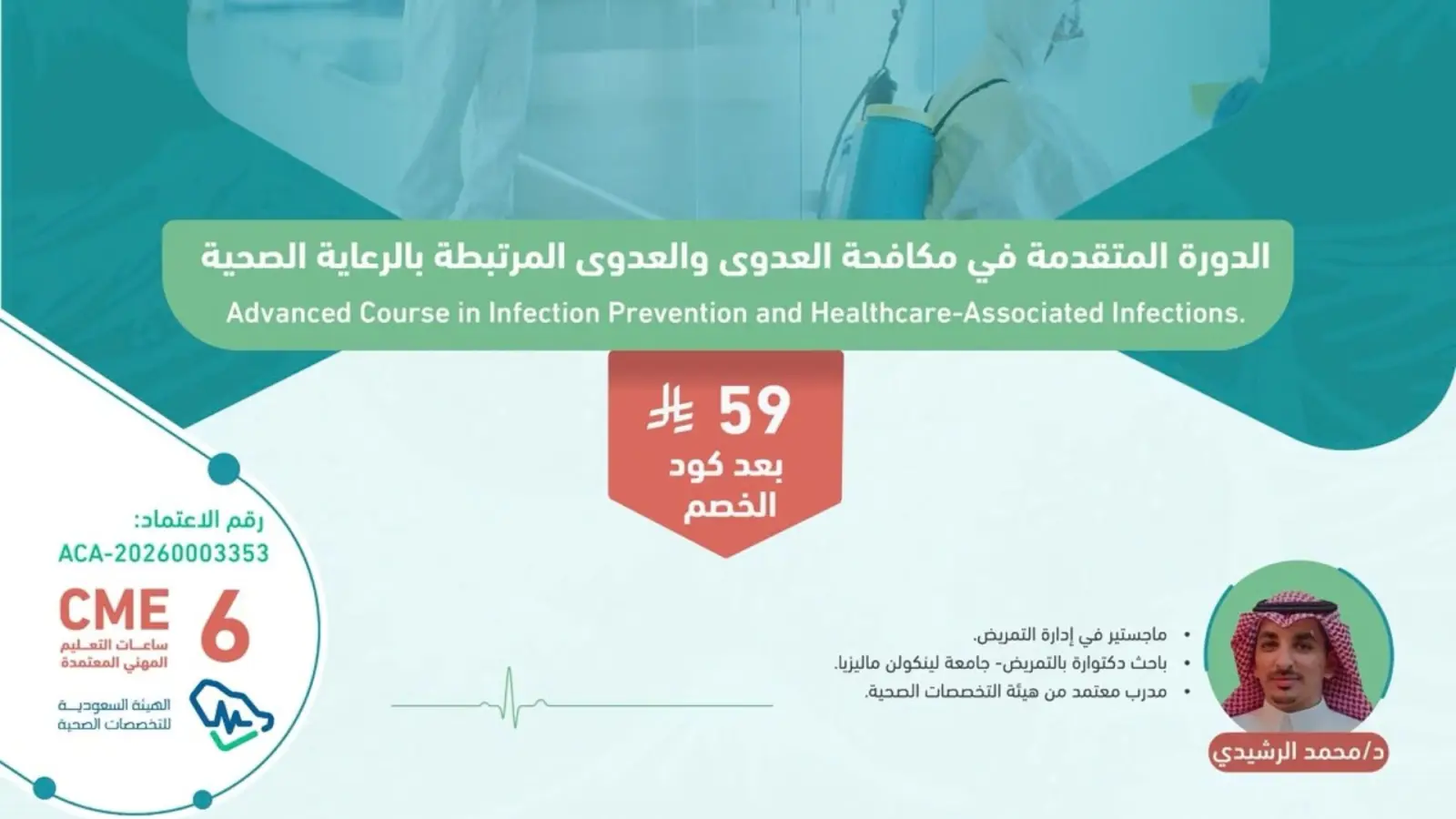
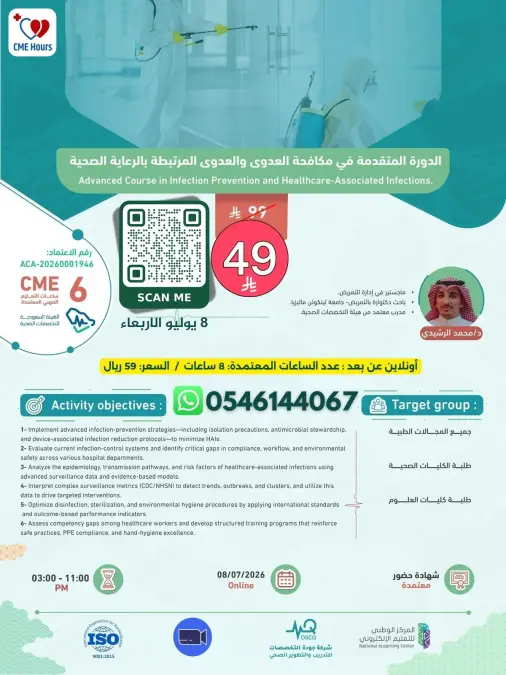
Advanced Course in Infection Prevention and Healthcare-Associated Infections #2
Important Notices Regarding the Course
Please take note of the following:
⏱️ The course hours may take up to 5 days to be credited after the course concludes.
🔗 The Zoom link for the course will be shared within the dedicated Telegram group. You can find the group's join link in your registration details page.
📜 Certificates are not issued automatically. You must request yours through technical support 4 days after the course ends.
Thank you for your understanding. We wish you a rewarding learning experience.
Please take note of the following:
⏱️ The course hours may take up to 5 days to be credited after the course concludes.
🔗 The Zoom link for the course will be shared within the dedicated Telegram group. You can find the group's join link in your registration details page.
📜 Certificates are not issued automatically. You must request yours through technical support 4 days after the course ends.
Thank you for your understanding. We wish you a rewarding learning experience.
QUALITY SPECIALTIES HEALTH SERVICES
Registration Ended

Live online via Zoom
SCFHS-accredited
Attendance certificate
Hours uploaded 2-4 days after the course
Course Objectives
Analyze the epidemiology, transmission pathways, and risk factors of healthcare-associated infections using advanced surveillance data and evidence-based models.
Evaluate current infection-control systems and identify critical gaps in compliance, workflow, and environmental safety across various hospital departments.
Implement advanced infection-prevention strategies—including isolation precautions, antimicrobial stewardship, and device-associated infection reduction protocols—to minimize HAIs.
Optimize disinfection, sterilization, and environmental hygiene procedures by applying international standards and outcome-based performance indicators.
Design comprehensive infection-control plans tailored to high-risk units such as ICUs, operating rooms, dialysis centers, and oncology wards.
Interpret complex surveillance metrics (CDC/NHSN) to detect trends, outbreaks, and clusters, and utilize this data to drive targeted interventions.
Lead multidisciplinary response teams in managing suspected or confirmed outbreaks within healthcare facilities using structured incident-management frameworks.
Integrate advanced risk-assessment tools to predict, prioritize, and mitigate infection hazards related to clinical practices, medical devices, and hospital infrastructure.
Assess competency gaps among healthcare workers and develop structured training programs that reinforce safe practices, PPE compliance, and hand-hygiene excellence.
Strengthen healthcare system resilience by applying global best practices (CDC, WHO, ECDC) to enhance preparedness for emerging pathogens and antimicrobial resistance threats.
Course Schedule
Scientific Program: Advanced Horizons in Infection Control & Healthcare Epidemiology
Day 1: Wednesday, July 08, 2026
| Time | Session Details |
|---|---|
| 03:00 PM 04:00 PM |
Epidemiology & Global Burden of HAIs
Advanced concepts in infection transmission dynamics, global and regional epidemiological trends, emerging pathogens, and evolving antimicrobial resistance patterns aligned with international benchmarks (CDC, WHO, ECDC).
Session Type: Lecture
|
| 04:00 PM 05:00 PM |
Sterilization, Disinfection & Environmental Decontamination Standards
Advanced hospital sterilization workflows, high-level disinfection technologies, validation indicators, biological monitoring, performance audits, and environmental microbiology.
Session Type: Lecture
|
| 05:00 PM 06:00 PM |
Surveillance Systems & Data Analytics in Infection Control
Designing active vs. passive surveillance systems, employing NHSN/WHO surveillance definitions, predictive analytics, early warning systems, and data interpretation for targeted HAI reduction strategies.
Session Type: Lecture
|
| 06:00 PM 07:00 PM |
Advanced Isolation Precautions & Infection-Prevention Protocols
Transmission-based precautions for critical pathogens, engineering controls (negative pressure rooms, airflow management), personal protective equipment optimization, and failure analysis models.
Session Type: Lecture
|
| 07:00 PM 07:15 PM |
Break (Coffee & Lunch) |
| 07:15 PM 08:00 PM |
Management of High-Risk Healthcare Procedures
Invasive procedures and infection risk modeling, Central Line-Associated Bloodstream Infections (CLABSI), Ventilator-Associated Events (VAE), Catheter-Associated Urinary Tract Infections (CAUTI), and surgical site prevention.
Session Type: Lecture
|
| 08:00 PM 09:00 PM |
Antibiotic Stewardship & Resistance Prevention Strategies
Mechanisms of multidrug resistance, hospital-wide antimicrobial stewardship frameworks, advanced prescribing audits, real-time feedback tools, de-escalation strategies, and antimicrobial clinical optimization.
Session Type: Lecture
|
| 09:00 PM 10:00 PM |
Outbreak Detection, Investigation & Response
Root-cause analysis for infection clusters, molecular typing and whole-genome sequencing in outbreak tracing, incident-command structure, rapid response multi-disciplinary teams, and containment/recovery planning.
Session Type: Lecture
|
| 10:00 PM 10:45 PM |
Leadership, Risk Management & Quality Improvement in Infection Control
Building a hospital-wide clinical safety culture, risk assessment matrices, Failure Mode and Effects Analysis (FMEA), policy development, national/international accreditation standards (JCI, CBAHI), and sustainable KPI programs.
Session Type: Lecture
|
| 10:45 PM 11:00 PM |
Interactive Q&A and Concluding Session
|
Total Accredited CME Hours: 06:00 Hours
Target Audience
For All Health Practitioners
Accreditation Information
Accreditation number: ACA-20260001946
Activity organizing entity: Qosco for health services
More Upcoming Courses
Other accredited courses you might like