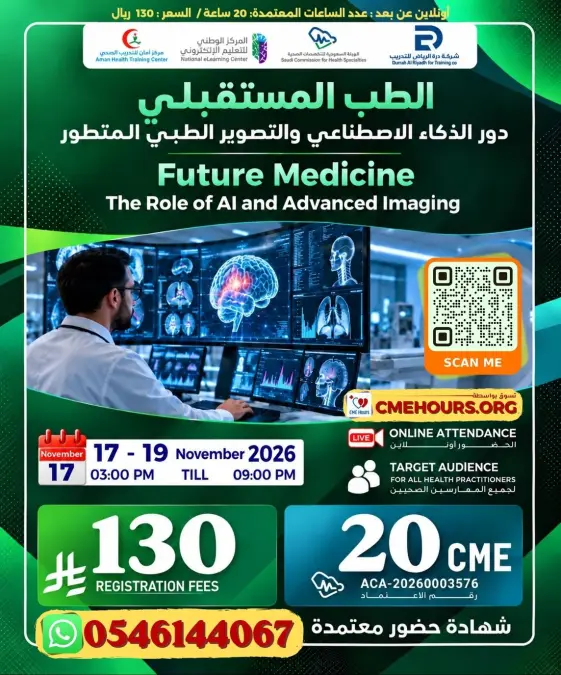
Future Medicine The Role of AI and Advanced Imaging

Register in 3 easy steps
Fully online via Zoom- 1
-
2
Pay & upload the receipt
The bank details and receipt upload are right inside the registration step.
-
3
Get your hours
Hours are uploaded within 2–4 days after the course ends.
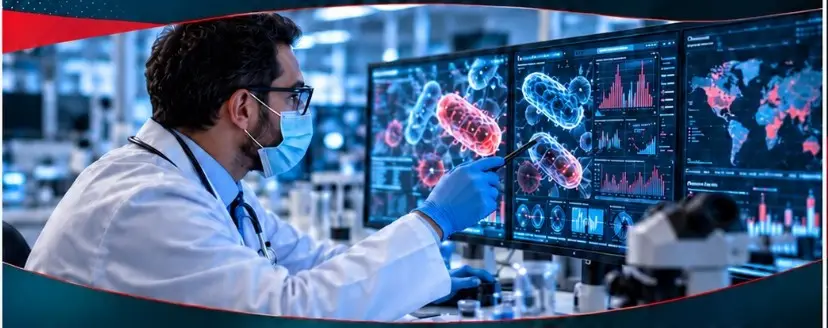
Step into the Future of Smart Medicine and Surgical Excellence! Artificial Intelligence is rapidly redefining the boundaries of clinical diagnostics and surgical precision. Accredited with 20 CME hours, this intensive course provides an exceptional opportunity to master the integration of AI, radiomics, and robotic assistance in clinical workflows. Whether you are a surgeon, family physician, or radiologist, this program equips you with the cutting-edge skills to utilize big data for operative planning, enhance diagnostic accuracy, and implement low-bias autonomous systems, positioning you as a pioneer in 21st-century healthcare.
Future Medicine: Revolutionizing Diagnostics and Surgery Through AI and Advanced Imaging
The healthcare sector is on the brink of a new era driven by artificial intelligence and advanced medical imaging, where technology and clinical medicine converge to deliver highly precise, personalized care. This scientific program explores how these disruptive technologies are fundamentally transforming clinical decision-making across diverse medical specialties.
Advanced Radiomics and Early Diagnostic Detection
The course begins by analyzing new imaging technologies, such as utilizing radiomics for COVID-19 imaging interpretation and retinal-vessel segmentation for the early detection of ocular diseases. It also highlights the critical role of AI in enhancing cancer detection accuracy and addressing the challenge of minimizing human bias to build fairer, more equitable medical innovations.
Biomedical Informatics and Data-Driven Surgery
The curriculum transitions to the pivotal role of big data, cloud, and fog computing in operative planning. Sessions cover the application of data-driven deep search in esophageal and rectal cancer surgeries, alongside recent developments in intestinal obstruction and modern hernia repairs. Participants will also explore strategies for optimizing surgical machine performance and developing autonomous surgical platforms.
Innovations in GI Endoscopy and Primary Care
A significant portion of the program is dedicated to AI applications in gastroenterology, including advanced endoscopic techniques to improve polyp detection and updates in NAFLD management. Furthermore, the course examines the evolving role of family physicians in this new era, evaluating how custom-designed clinical solutions can empower patient-centered care. The program concludes with critical discussions on the potential, challenges, and future trajectory of general surgery amidst rapid autonomous advancements.
More Upcoming Courses
Other accredited courses you might like