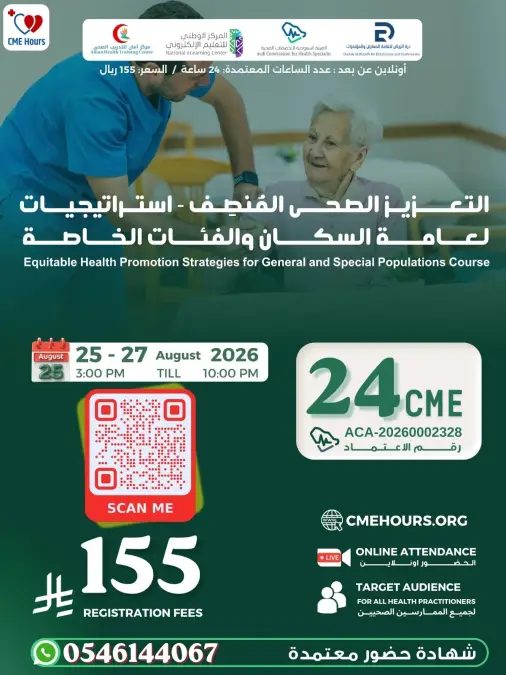
Equitable Health Promotion Strategies for General and Special Populations Course #2
Durrat Riyadh for Exhibition Organizing
Registration Ended

Live online via Zoom
SCFHS-accredited
Attendance certificate
Hours uploaded 2-4 days after the course
Course Objectives
Explain the key concepts, theories, and models of health promotion and disease prevention.
Demonstrate knowledge of behavior change theories (e.g., Social Cognitive Theory, Transtheoretical Model), social-ecological models, and other relevant concepts that guide health promotion interventions.
Assess the health needs and risks of a target population or community using epidemiological data and other relevant information.
Analyze and interpret quantitative and qualitative data, such as demographic information, disease prevalence, and social determinants of health, to inform the development of health promotion programs.
Develop evidence-based health promotion and disease prevention strategies and interventions that address the identified needs and risks.
Implement health promotion programs and activities using appropriate communication, education, and advocacy techniques.
Utilize various health education and communication techniques, such as mass media campaigns, interpersonal counseling, and community-based workshops, to promote healthy behaviors and environments
Evaluate the effectiveness of health promotion and disease prevention initiatives and use the findings to inform future program planning and improvement.
Demonstrate an understanding of the role of various stakeholders, including policymakers, healthcare providers, community organizations, and the public, in promoting population health.
Apply ethical principles and public health frameworks in the design, implementation, and evaluation of health promotion and disease prevention efforts.
Describe the key social, economic, environmental, and cultural factors that influence the health and well-being of various special populations (e.g., racial/ethnic minorities, people with disabilities, the elderly, low-income communities, etc.).
Analyze quantitative and qualitative data to identify the specific health needs, assets, and priorities of special populations within a given community or context.
Develop culturally responsive and evidence-based health promotion strategies and interventions that address the unique needs and preferences of special populations.
Demonstrate the ability to effectively engage and collaborate with members of special populations, community organizations, and other stakeholders in the design and implementation of health promotion programs.
Evaluate the reach, effectiveness, and sustainability of health promotion initiatives targeting special populations, and use the findings to inform continuous improvement.
Advocate for policies, systems, and environmental changes that promote health equity and address the social determinants of health for special populations.
Exhibit cultural humility, empathy, and a commitment to social justice in their approach to health promotion practice.
Identify common barriers (e.g., linguistic, cultural, financial, structural) that limit access to health promotion services for special populations during a case study analysis.
Reflect on one's own potential biases and assumptions about a special population of choice in a structured self-assessment journal entry to be completed by the course’s conclusion.
Appreciate the intersectionality of factors (race, gender, disability, socioeconomic status) that shape an individual's health experience, as measured through a pre- and post-activity attitude survey.
Develop a health literacy audit for a standard patient education material, identifying and revising three complex elements.
Design a framework for a targeted health promotion campaign for a specific special population, outlining at least two tailored messaging strategies and two appropriate outreach channels.
Create a referral map of five local community-based organizations that address social determinants of health (e.g., food pantries, housing assistance, legal aid) relevant to their patient population.
Apply a health equity impact assessment tool to a proposed clinic policy or program to identify potential unintended consequences for vulnerable groups.
Course Schedule
Scientific Program: Health Promotion, Disease Prevention, and Health Equity Strategies
Day 1: Tuesday, August 25, 2026
| Time | Session Details |
|---|---|
| 03:00 PM 04:00 PM |
Introduction to Health Promotion and Disease Prevention
Session Type: Lecture
|
| 04:00 PM 05:00 PM |
The Role of Epidemiology in Health Promotion
Session Type: Lecture
|
| 05:00 PM 06:00 PM |
Health Behavior Theories and Models
Session Type: Lecture
|
| 06:00 PM 07:00 PM |
Assessing Community Health Needs
Session Type: Lecture
|
| 07:00 PM 07:30 PM |
Opening Discussion Panel I |
| 07:30 PM 08:30 PM |
Community Health Indicators
Session Type: Lecture
|
| 08:30 PM 09:30 PM |
Community Health Problems
Session Type: Lecture
|
| 09:30 PM 10:30 PM |
Stakeholders Engagement and Building Partnerships
Session Type: Lecture
|
| 10:30 PM 11:30 PM |
Developing Health Promotion Interventions
Session Type: Lecture
|
| 11:30 PM 11:45 PM |
Day 1 Closing Discussion Panel |
Day 2: Wednesday, August 26, 2026
| Time | Session Details |
|---|---|
| 03:00 PM 04:00 PM |
Health Communication Strategies
Session Type: Lecture
|
| 04:00 PM 05:00 PM |
Policy, Advocacy, and Systems Change for Health Equity
Session Type: Lecture
|
| 05:00 PM 06:00 PM |
Introduction to Health Disparities and Social Determinants of Health
Session Type: Lecture
|
| 06:00 PM 07:00 PM |
Racial and Ethnic Health Disparities
Session Type: Lecture
|
| 07:00 PM 07:30 PM |
Interactive Discussion Panel II |
| 07:30 PM 08:30 PM |
Assessing the Health Needs and Assets of Special Populations
Session Type: Lecture
|
| 08:30 PM 09:30 PM |
Health Promotion for Individuals with Disabilities
Session Type: Lecture
|
| 09:30 PM 10:30 PM |
Promoting Healthy Aging in Older Adult Populations
Session Type: Lecture
|
| 10:30 PM 11:30 PM |
Strategies for Effective Cross-Cultural Communication and Community Engagement
Session Type: Lecture
|
| 11:30 PM 11:45 PM |
Day 2 Wrap-up Panel Discussion |
Day 3: Thursday, August 27, 2026
| Time | Session Details |
|---|---|
| 03:00 PM 04:00 PM |
Open Discussion & Assessment Findings Review
Session Type: Interactive Forum
|
| 04:00 PM 05:00 PM |
Assessment Findings into Action: Developing Community Health Programs
Session Type: Lecture
|
| 05:00 PM 06:00 PM |
Health Literacy and Numeracy: Making Information Accessible
Session Type: Lecture
|
| 06:00 PM 07:00 PM |
Using Digital Health Technology to Bridge Equity Gaps
Session Type: Lecture
|
| 07:00 PM 07:30 PM |
Interactive Panel Discussion III |
| 07:30 PM 08:30 PM |
Maternal and Child Health Promotion in Vulnerable Communities
Session Type: Lecture
|
| 08:30 PM 09:30 PM |
Sustainable Funding and Grant Writing for Equity-Focused Programs
Session Type: Lecture
|
| 09:30 PM 10:30 PM |
Mental Health First Aid and Promotion in Community Settings
Session Type: Lecture
|
| 10:30 PM 11:30 PM |
Trauma-Informed Approaches in Health Promotion
Session Type: Lecture
|
| 11:30 PM 11:45 PM |
Comprehensive Open Discussion & Program Wrap-up
|
Total Accredited CME Hours: 24:00 Hours
Target Audience
For All Health Practitioners
Accreditation Information
Accreditation number: ACA-20260002328
Activity organizing entity: Aman co. treatment health training
Have a question? Message us on WhatsApp
Contact Us
More Upcoming Courses


United Against Bacterial Resistance A Multidisciplinary...
21 hrs
116 SAR

Sustainable Health Starts with Lifestyle Medicine #2
18 hrs
99 SAR

Strategies in Healthcare Risk Management #2
20 hrs
129 SAR