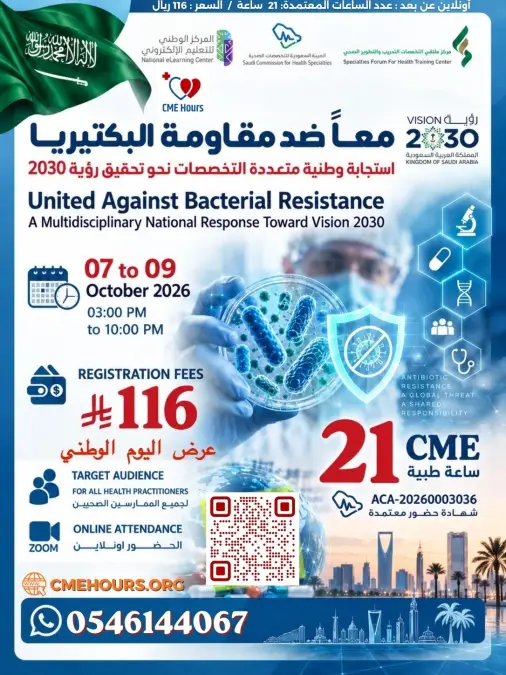
United Against Bacterial Resistance A Multidisciplinary National Response Toward Vision 2030 #2

Champion the National Interprofessional Front Against Antimicrobial Resistance! Antimicrobial resistance (AMR) is a paramount global healthcare threat that jeopardizes modern therapeutic interventions and patient safety. Accredited with 21 CME hours, this essential multidisciplinary course aligns hospital operations with national action plans and Saudi Vision 2030 healthcare objectives. By participating, you will gain practical, evidence-based competencies in establishing robust Antimicrobial Stewardship Programs (ASPs), managing difficult-to-treat multidrug-resistant (MDR) infections, integrating advanced diagnostic surveillance, and implementing cross-departmental containment protocols to protect patients and preserve antimicrobial efficacy.
Antimicrobial resistance (AMR) represents one of the most critical threats facing modern healthcare delivery, demanding coordinated, interprofessional interventions across all tiers of clinical practice. This extensive training course delivers an authoritative and actionable blueprint to mitigate bacterial resistance, enhance antimicrobial governance, and protect vulnerable patient populations in line with national and global health mandates.
Global & National Epidemiology, Mechanisms, and One Health
The curriculum opens by evaluating global surveillance data, national trends, and the socioeconomic burdens imposed by drug-resistant pathogens. Faculty dissect molecular mechanisms of bacterial resistance and explore emerging multidrug-resistant threats. These dynamics are analyzed through the One Health framework, highlighting the critical intersections among human medicine, veterinary practices, and environmental reservoirs that accelerate resistance dissemination.
Infection Prevention, Outbreak Management, and Diagnostic Integration
Participants explore core infection prevention and control (IPC) standards engineered to interrupt nosocomial transmission pathways. The course details robust hospital surveillance architectures, active screening protocols, and outbreak investigation methodologies. Dedicated case discussions and interactive exercises underscore the shared roles of multidisciplinary teams—physicians, clinical pharmacists, microbiologists, and nursing staff—in executing coordinated containment strategies.
Clinical Antimicrobial Stewardship Programs (ASP) and Therapeutics
Central modules concentrate on designing, executing, and monitoring high-impact Antimicrobial Stewardship Programs (ASPs). The program highlights the role of clinical microbiology diagnostics and rapid susceptibility testing in tailoring prompt, pathogen-directed therapy. Clinicians will analyze therapeutic options for multidrug-resistant (MDR) Gram-negative and Gram-positive infections, address drug shortages and access barriers, and formulate specialized regimens for high-risk cohorts, including neonatal, geriatric, and immunocompromised patients.
Institutional Leadership, Vision 2030 Alignment, and Future Horizons
Concluding sessions examine leadership responsibilities, clinical governance, and policy translation within healthcare institutions. The program demonstrates how hospital performance indicators align with Saudi Arabia's National Action Plan on AMR and broader Vision 2030 healthcare transformation goals. Finally, participants review continuous quality improvement (CQI) methodologies, patient and community behavioral empowerment strategies, and emerging biomedical innovations, ensuring healthcare organizations build resilient, sustainable defense systems against bacterial resistance.
More Upcoming Courses

Future Medicine The Role of AI and Advanced Imaging #2

Health Emergency and Disaster Response A Multidisciplin...